
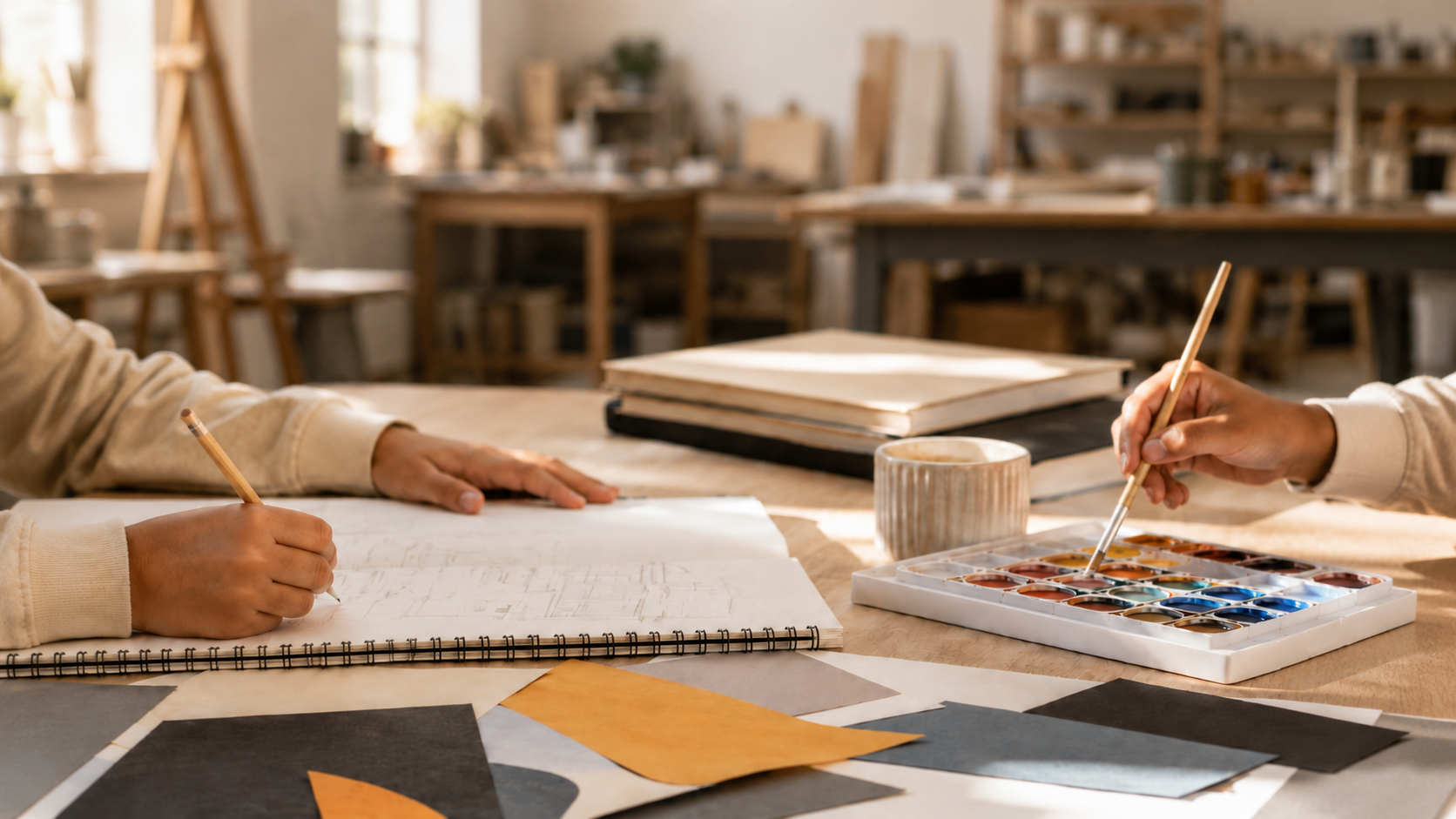
A child learning a song is doing more than memorizing notes. She is listening for rhythm, following a sequence, adjusting her voice, and staying attentive to others around her. A student working on a drawing is also doing more than filling a page. He is studying shape, space, and detail, then revising when what appears on paper does not yet match what he sees.
These classroom moments show that arts education is not separate from thinking. For students in Grades 1 to 8, the arts give children active ways to practice memory, interpretation, problem-solving, communication, and sustained attention. These are not only artistic skills. They are learning habits that support a child’s development across the school day.
In an arts classroom, children are often asked to slow down and notice carefully. In music, this may mean listening for timing and rhythm. In visual arts, it may mean seeing how a small change in line or color changes the whole image. In drama, it may mean learning how voice and movement affect meaning. Over time, this kind of focused attention helps children become more careful observers and listeners.
That habit can carry into other areas of learning. A child who has learned to look carefully at an image may also become more attentive when reading a story, recognizing a pattern in math, or following a teacher’s directions. The connection should not be overstated, but the practice is valuable: the arts give children repeated opportunities to notice, adjust, and think with care.
The arts also help children remember and organize information. A student preparing for a performance has to hold words, cues, and timing in mind while staying aware of the group. A child learning an instrument connects what is heard, seen, and played through repeated practice. This kind of learning is active. Children are not only receiving information; they are arranging it, recalling it, and using it in real time.
Art also teaches children how to revise. A drawing may need adjustment. A scene may need clearer pacing. Students learn that revision is part of making the work clearer. They try again, change direction, compare choices, and notice what improves. Over time, this builds flexible thinking, the same kind of patience a child needs when revising a paragraph, reworking a science problem, or improving a presentation.
In Grades 1 to 8, this kind of practice is especially useful because children are still forming the habits that shape how they approach learning. Again, the arts give them a place to focus, remember, listen, respond, cooperate, and stay with a task long enough to improve it. They also give different kinds of learners another way to participate. A child who may hesitate in one setting may find confidence through drawing, music, or movement.
At Giles School, the arts are part of the student experience through music, visual arts, drama, recitals, performances, and exhibitions. These experiences connect naturally with academic learning and multilingual education because they ask students to express ideas clearly, work with others, and present with confidence. The emphasis is on giving children meaningful ways to think, communicate, and grow.
Parents and educators can support this process by paying attention to how children work, not only to what they produce. When adults notice effort, revision, attention, and expression, children begin to see the arts as more than an activity. They begin to see them as part of how they learn.
In a strong education, the arts are not placed at the edge of learning. They help form the habits that make deeper learning possible.